

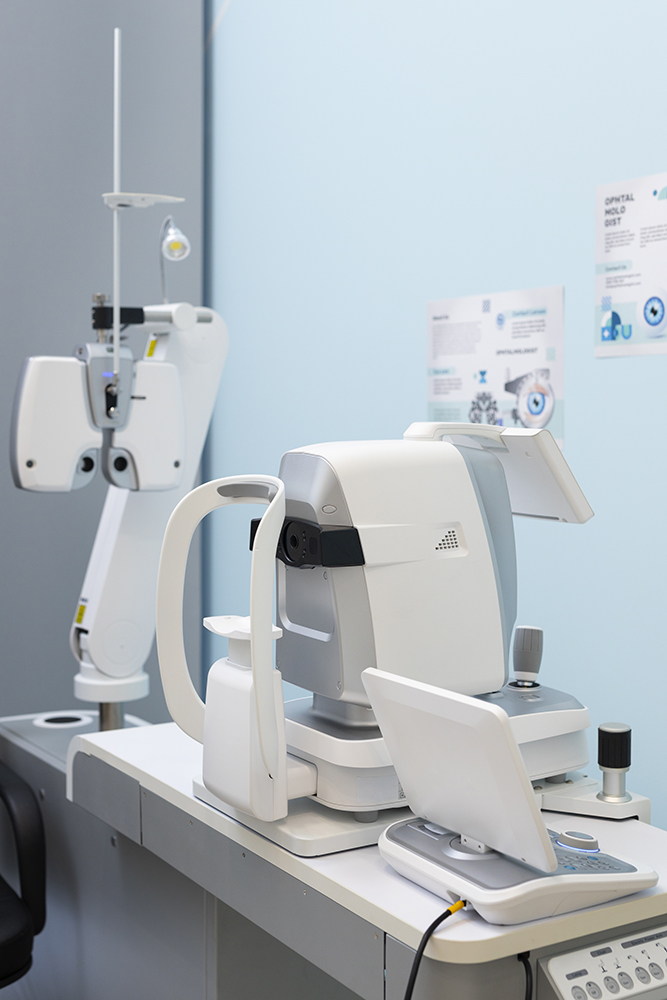


If your vision is getting cloudier and reading or night driving is becoming difficult, you can start with an eye exam. All cataract surgeries are performed at ClearJoy Eye Center on Bo'ai 4th Rd. in Zuoying District, Kaohsiung. Dr. Chunyu Lin will discuss your vision concerns and explain your options. This guide covers when to get an eye exam, surgical techniques, intraocular lens options, what Taiwan's National Health Insurance (NHI) covers, out-of-pocket costs, and follow-up visits.
When Should You Be Evaluated for Surgery, and When Might Your Doctor Recommend Monitoring First?
Cloudy vision, faded colors, glare or halos around headlights at night, frequent prescription changes with limited improvement from new glasses, and difficulty reading or driving can all be warning signs of cataracts 1,2 (see Common Cataract Symptoms) .
Surgery can be considered before cataracts become advanced. If they interfere with daily life, you can come in for an exam and discuss your options 2. If an exam shows that the cataract is still mild or not causing noticeable vision trouble, Dr. Chunyu Lin will recommend regular monitoring rather than rushing into surgery. If you also have conditions such as macular disease or glaucoma, visual improvement after surgery may be more limited—which is why a pre-op dilated fundus exam is especially important 2,3.
How Do Minimally Invasive Cataract Surgery (Phacoemulsification) and Femtosecond Laser-Assisted Cataract Surgery (ALLY) Work?
Cataract surgery is performed at our clinic, and your doctor will explain the anesthesia method and surgical details based on your pre-op evaluation. Minimally invasive phacoemulsification removes the cloudy lens through an incision of about 2 mm, typically without requiring stitches 3. A femtosecond laser can assist with creating the opening and pre-fragmenting the lens, and is usually still followed by phacoemulsification 3.
Not everyone needs a femtosecond laser. Whether to use it will be discussed based on your exam results, cataract density, corneal condition, and daily visual needs. To learn more about both approaches, see Micro-Incision Cataract Surgery and Femtosecond Laser-Assisted Cataract Surgery (ALLY).
Pre-Op Measurements and Surgical Alignment
Calculating the right intraocular lens (IOL) power relies on thorough pre-op eye measurements 2,3. Before surgery, our clinic uses ARGOS to measure axial length, corneal curvature, and other ocular data as a key basis for calculating lens power.
If a toric IOL is considered for astigmatism, precise axis alignment is very important. When needed, the doctor imports ARGOS data into the VERION image-guided system to assist with toric IOL alignment, and double-checks it with manual marking.
How to Choose an Intraocular Lens (IOL): Let's Start with Your Daily Visual Needs
After the cloudy natural lens is removed, an intraocular lens (IOL) is implanted to replace it 2. In addition to standard monofocal IOLs covered by NHI, your doctor can assess whether an advanced IOL is suitable for you. Options include toric lenses for astigmatism, extended-depth-of-focus lenses, and multifocal lenses 3,4.
No single IOL suits everyone. Each type meets different needs and involves trade-offs. Your doctor will ask about the distances you need to see at and the tasks you do, such as using a computer or phone, looking into the distance, and driving at night. You will discuss when you might still need glasses after surgery and decide together based on your needs and the results of exams of the cornea and the back of your eye. For details, see Advanced Intraocular Lenses (IOLs).
What Does Taiwan's National Health Insurance Cover, and What Might You Pay Out of Pocket?
When National Health Insurance (NHI) eligibility criteria are met, cataract surgery and a standard IOL are covered by NHI 4,5. Eligibility must be determined through an ophthalmologist's exam—it is not based on age alone—and actual coverage follows the latest National Health Insurance Administration (NHIA) regulations.
If you choose a special-function IOL eligible for partial NHI coverage, you pay the difference above the NHI-covered amount out of pocket 4. Femtosecond laser assistance is an out-of-pocket option. After your exam, your doctor will explain the differences in person to you and your family so you can decide comfortably.
Our Clinic's Process: From Pre-Op Evaluation and Surgery to Post-Op Follow-Up
Knowing the schedule for each step can give you greater peace of mind (see Pre-Op Evaluation & Post-Op Follow-Up) :
- Pre-op exam: Usually 1 to 2 clinic visits are scheduled before surgery, or more depending on exam findings. Please set aside at least 1.5 hours for the pre-op exam—we recommend allowing 1.5 to 2 hours. Exams include visual acuity, pupil dilation to examine the lens and fundus, and ocular measurements with ARGOS 2. After pupil dilation, we recommend having a family member accompany you—please do not drive or ride a scooter yourself.
- Day of surgery: Surgery is performed at our Zuoying clinic. We recommend allowing 1.5 to 2 hours on the day of surgery. Most patients do not need hospitalization; after the doctor's check and placing a protective eye shield, you may go home accompanied by family—please do not drive yourself that day 2.
- Follow-up visits and time between surgeries on each eye: A follow-up visit is usually scheduled for the next day, with subsequent visits and eye drops adjusted based on your recovery. Recovery speed varies from person to person; most patients stabilize gradually over several days to a few weeks. Avoid rubbing your eyes during the first few weeks 2. Under NHI review guidelines, surgeries for both eyes should generally be spaced at least one week apart, except in special circumstances 5 (see Scheduling Surgery for Both Eyes) .
- Post-op warning signs requiring prompt care: If your vision suddenly gets worse, eye pain or redness increases, many new floaters appear suddenly, or you suddenly see flashes of light, contact an eye clinic for immediate care. If you cannot reach an eye clinic or get an eye exam right away, go straight to the emergency room 2. A small number of patients may develop complications after surgery, such as inflammation, infection, increased pressure inside the eye, or retinal detachment. Prompt evaluation is important 2.
If you are traveling to our Zuoying clinic from another county/city or from Pingtung, please check our Clinic Location and Clinic Hours beforehand so you can plan your travel and arrange for a family member to accompany you.
Cataract Surgery FAQ
Q1: Do cataracts have to become advanced before surgery?
No. You can come in for an evaluation as soon as blurry vision or light sensitivity begins affecting your daily life 2. If the cataract is still mild and causes little difficulty with your vision, your doctor may suggest monitoring it first.
Q2: Is femtosecond laser-assisted cataract surgery (ALLY) always necessary?
Not necessarily. Phacoemulsification is used to remove the cloudy lens, while a femtosecond laser can assist with certain steps and is usually still followed by phacoemulsification 3. Whether to use the laser will be discussed based on your cataract density, corneal condition, and visual needs.
Q3: Is hospitalization required? How far apart are surgeries for both eyes?
Most patients do not require hospitalization and can go home accompanied by family on the day of surgery after the doctor's check 2. Under NHI review guidelines, surgeries for both eyes should generally be spaced at least one week apart, except in special circumstances 5.
Q4: How do I know if I qualify for National Health Insurance (NHI) coverage?
Eligibility must be evaluated through an ophthalmologist's exam and follows the latest NHIA regulations—it is not determined by age alone. When criteria are met, a standard IOL is covered by NHI; choosing a partially covered special-function IOL requires paying the difference out of pocket 4; femtosecond laser assistance is an out-of-pocket option.
If you or a family member have recently noticed increasingly cloudy vision and would like a cataract evaluation, you can contact us via our official LINE account or Phone to book an appointment.
This page provides patient education information and does not replace an in-person exam. Please rely on your doctor's clinical assessment for your eye condition and treatment options.
References
- National Eye Institute. Cataracts (Updated 2026-08-19)
- National Eye Institute. Cataract Surgery (Updated 2024-12-05)
- Miller KM, et al. Cataract in the Adult Eye Preferred Practice Pattern. Ophthalmology. 2022;129(1):P1–P126. PMID 34780842
- National Health Insurance Administration, Ministry of Health and Welfare. Compilation of NHI Partial Coverage for Special-Function Intraocular Lenses — Public Guide (NHIA Official Website, search keywords: 特殊功能人工水晶體 民眾篇)
- National Health Insurance Administration, Ministry of Health and Welfare. National Health Insurance Medical Expense Review Guidelines (Ophthalmology — Cataract Surgery Provisions) (NHIA Official Website, search keywords: 全民健康保險醫療費用審查注意事項 眼科 白內障 間隔一週)
Updated: 2026-11-26 | Author: Dr. Chunyu Lin, Director